How to Eat Tinned Fish
A tin of fish is a finished dish. The only question is what to put under it: bread most of the time, a baguette above all, and a whole family of bases that work the same way. Here is the one move you can do to enjoy tinned fish.
Every tin of fish arrives finished. A wild animal that grew in open water (unless it was farmed), caught at the right season, cleaned, cooked, and packed by hand by someone who took it seriously. And the fish is only half of what they packed: the oil or the sauce around it has been quietly working since the day the tin was sealed, drawing flavor out of the fish and feeding it back in. By the time you open it, some of the best eating is in that liquid. So the whole craft of eating a tin comes down to one friendly question: what do you put under it, so that nothing in the tin goes to waste?
While any tin can be eaten in the following way, this guide will focus on sardines because there are more sizes, more preparations, and more range than anything else in the tin. From plain in olive oil to tomato, escabeche, piri-piri, or butter. Learn to eat a sardine well and you can eat almost anything in the aisle. And the one thing to eat it on, most of the time, is bread. Specifically, a baguette.
This is a point worth being clear about: bread is not a beginner's step you graduate out of. This is the one move whether it is your first tin or your hundredth, it is the simplest, most portable, most complete way to eat almost anything that comes in a tin. Everything else, the preparations, the pairings, the other bases, branches off from this. Get the bread right and you have the whole thing; the rest is just happy variation.
Why the baguette
There is a reason the French built a civilization around it, and a reason you can find a baguette in nearly any supermarket. It is the most useful bread there is and also one of the cheapest. The crust gives structure, the crumb soaks up oil and sauce, and the flavor is neutral enough to let the fish lead while still being a real, substantial mouthful. It turns a tin from a snack into a meal, and it travels: a baguette and a tin is a lunch you can eat literally anywhere, which is close to how this food was eaten in Europe long before it became a trend.
Take a boat down the Seine toward sunset and you will see people strung all along the banks, couples, families, and friends sitting on the stone with a baguette, a bottle of wine, and a few things to pick at between them. In Galicia and Portugal it is the same, the tin set down among the cheese and the olives and the cured meat, the bread within reach. The fish is the guest of honor; the bread is simply always there.
A baguette does its best work in big pieces:
- Torn into chunks. Tear off wide pieces. A torn piece has a soft face that grabs oil and a crust that holds together. It is built for dipping into the tin and layering fish on top.
- Split lengthwise. Cut a section in half the long way and you have a vessel: a long open face to load with fish, or the makings of a sandwich. This is the single most useful move with a tin.
Break the fish up
The intact piece of fish in the tin is there for a reason: so you can see that it is a quality piece, whole, properly packed, cared for. It is worth a moment of appreciation. But it does not have to stay intact on the way to your mouth. Once you have looked at it, lightly break the fish up into its own oil or sauce, right there in the tin, and use the result as a spread or topping. Now everything in the tin, the oil, the soft bits, the sauce, goes onto the bread together instead of being left behind in the can. A mashed, layered, oil-soaked piece of baguette carries the whole tin, fish and liquid both.
When you finish, tear a plain piece and mop up whatever is left. Nothing in that tin is meant to be discarded.
Warm the tin first
If you are at home, this is the single best thing you can do to a tin. Drop the unopened tin in a bowl of hot tap water for at least five minutes before you open it, while you're warming a baguette section. The difference is not subtle. Cold from the shelf, the oil is thick and a little dull and the fish is firm; the flavors stay locked up. Warmed through, the oil loosens and turns silky and the fat in the fish softens. A tin that you thought was good at room temp can be remarkably elevated when warmed. Same tin, same fish, just completely woken up.
This is not only for oil-packed tins. The sauced ones can benefit even more. A warmed tin of sardines in tomato, escabeche, or a spiced sauce like tikka masala or piri-piri, the sauce comes alive the same way it would in a pan. It stops tasting like something in a can and starts tasting like a just-prepared meal.
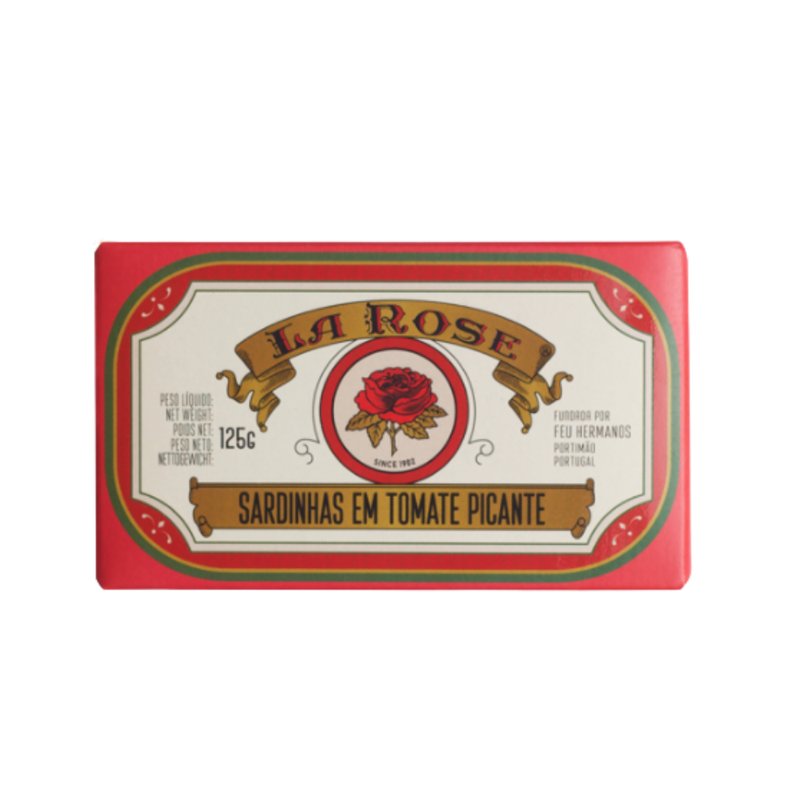
One to know · Best warmed first
Sardines in Spicy Tomato SauceLa Rose · in stock at Portugalia Marketplace
Hot tap water in a bowl is enough; you are warming it through, not cooking it, so there is no stove and nothing to clean. If you are out, at a desk, on a picnic, with a baguette and a tin in a bag, then room temperature is completely fine and it always has been. This is a do-it-if-you-can elevation, not a rule. But if you are standing in your own kitchen, take the few minutes.
Two ways to do it
For tins in sauce, bread is enough. A tin in tomato, escabeche, or a spiced sauce already brings its own seasoning. Split the baguette, break the fish up into the sauce, pile it on, and tear more bread to chase the liquid at the bottom. Nothing else needed.
For tins in oil, you can step it up with pan con tomate. Split a length of baguette, drizzle it with olive oil, spread grated fresh tomato across it, add a little salt. Then layer the lightly broken up fish on top of that tomato bed. The tomato brings acidity and moisture, the oil ties it together, and a simple tin of sardines in olive oil becomes something you would order in a bar in San Sebastián, no passport required. Warm the tin first and it is better still.
Every base works
The baguette is the main move, not the only one. Almost anything plain and good carries a tin the same way: a pot of rice, a boiled potato, a bowl of pasta or noodles, eggs in the morning, a plate of greens, warm white beans, even a sturdy cracker under a smoked fillet. They are close to interchangeable, and that is the point: the base changes with what is in the cupboard, the move never does. Something plain underneath, the fish on top, the oil or sauce over everything.
Where to go next
How to eat premium tinned fish goes preparation by preparation: oil, smoke, escabeche, tomato, butter, shellfish, octopus. Types of tinned fish walks the species one at a time. The starter pantry is six tins worth buying first. And the two worlds of tinned fish makes sure you always know whether you are holding an ingredient can or a tin worth this kind of attention.